
The history of Dairy goats farming in Kenya precedes the existence of the Dairy goat association of Kenya. In order to narrate the history of DGAK without losing this important fact, we shall address the history in its known entirety but in brief form. The history of Dairy Goat farming in Kenya can therefore best be captured by splitting it into Pre-DGAK and Post-DGAK periods.
Pre-Association History
Dairy Goats farming in Kenya existed before independence. It was introduced in 1935 by the settler farmers. Later, after independence, the Government through donor assisted projects had been importing dairy goats since 1970. The imported goats were kept in government institutions which acted as multiplication centers. Individual farmers had been purchasing goats from these institutions. There was no breeding program in place resulting to inbreeding and thereby lowering the quality.
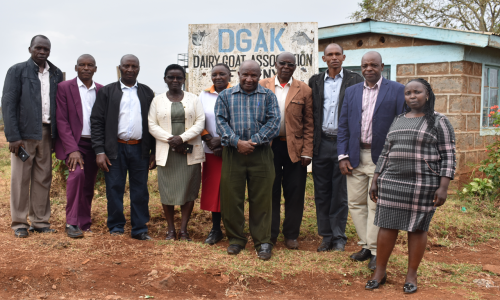
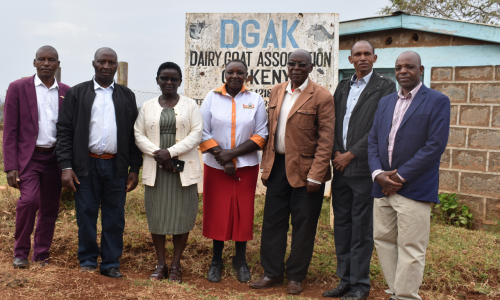
Recent History
All these imported bucks were have died due to old age. We are now using the upgraded pedigree bucks born in Kenya for services. So far over 200,000 upgraded goats have been born out of which 96,000 have been registered with Kenya Stud Book.
There are several dairy goat farmers registered under DGAK in our various branches across the country. There are also several activities being carried out to enhance dairy goat farming including training of farmers on animal /dairy goat husbandry and training of multipliers on effective breeding. DGAK has also been training office holders on good governance and effective office management in order to ensure quality services are delivered to dairy goat farmers.
Some of the existing challenges faced now are marketing of the products specifically dairy goats’ milk. A new study is needed to establish the current state and propose the way forward towards converting dairy goats farming into a vibrant industry with significant contribution in the economy especially so because of its ability to withstand climate change related problems.
DGAK Formation and Initial Developments
In 1989, it was discovered that dairy goat farming was severely affected by lack of quality breeding. Initial efforts were made in 1992 by crossbreeding the Kenyan goats (Small East Africa and Galla) with the German alpine under a project (The Integrated Small Livestock Project-ISLP ) spearheaded by the Government of Kenya (GOK) ministry of Livestock Development (MOLD) and Deutsche Gesellschaft für Technische Zusammenarbeit (GTZ) GmbH also referred to as German Technical Cooperation. Between 1992 and 1999, over 120 German Alpine bucks and 15 does were imported and contracted to leading farmers. ISLP resulted to the formation and registration of Dairy Goats Association of Kenya in April 1994. The formation of DGAK was intended to create a sustainable dairy goat farming enterprise that facilitates improved livelihoods through the development of a value-added agribusiness. For this reason, it needed to be community driven which is reflected by the fact that DGAK is national, non-governmental and non-profit association.